
Posture & Tech Neck
Hours at a desk or on your phone have a way of catching up with you — we can help you understand what is happening and what to do about it.
Understanding Posture & Tech Neck
We are spending more time than ever looking at screens — and our necks and upper backs are paying the price. The term "tech neck" has become a shorthand for the aching, stiffness, and tension that builds up from long hours hunched over a phone, laptop, or desk. But the problem goes deeper than just posture awareness.
When the head sits forward of its natural position — even by a few centimetres — the load on the cervical spine increases dramatically. A head that weighs 5 kg in a neutral position can place the equivalent of 20–25 kg of load on the neck when it is tilted forward at 45 degrees. Over hours of screen time each day, the muscles, joints, and discs of the cervical spine are under sustained, abnormal load. The result is not just discomfort — it can include joint stiffness, disc changes, muscle imbalances, and headaches that become increasingly frequent over time.
Rounded shoulders and a forward-head posture are not simply a matter of bad habits. They are often the result of muscle imbalances that develop from repetitive patterns — tight chest and anterior shoulder muscles, weakened deep neck flexors and upper back stabilisers — combined with joint stiffness that makes it physically harder to maintain an upright position. Telling someone to "just sit up straight" without addressing these underlying factors rarely produces lasting change. Our approach is to assess what is actually going on structurally and give you a care plan that makes improvement achievable.
Common symptoms
- Aching or tightness across the neck, upper shoulders, and between the shoulder blades
- A visibly forward-head or rounded-shoulder posture, particularly by the end of the day
- Stiffness and reduced range of motion when turning the head
- Tension headaches that build through the working day
- Upper back or between-the-shoulder-blade discomfort after sitting
- Pain or fatigue that worsens with phone use, laptop work, or long drives
- A feeling of being unable to sit comfortably upright for extended periods
- Neck and shoulder pain that is better on weekends and worse by Friday
How chiropractic may help
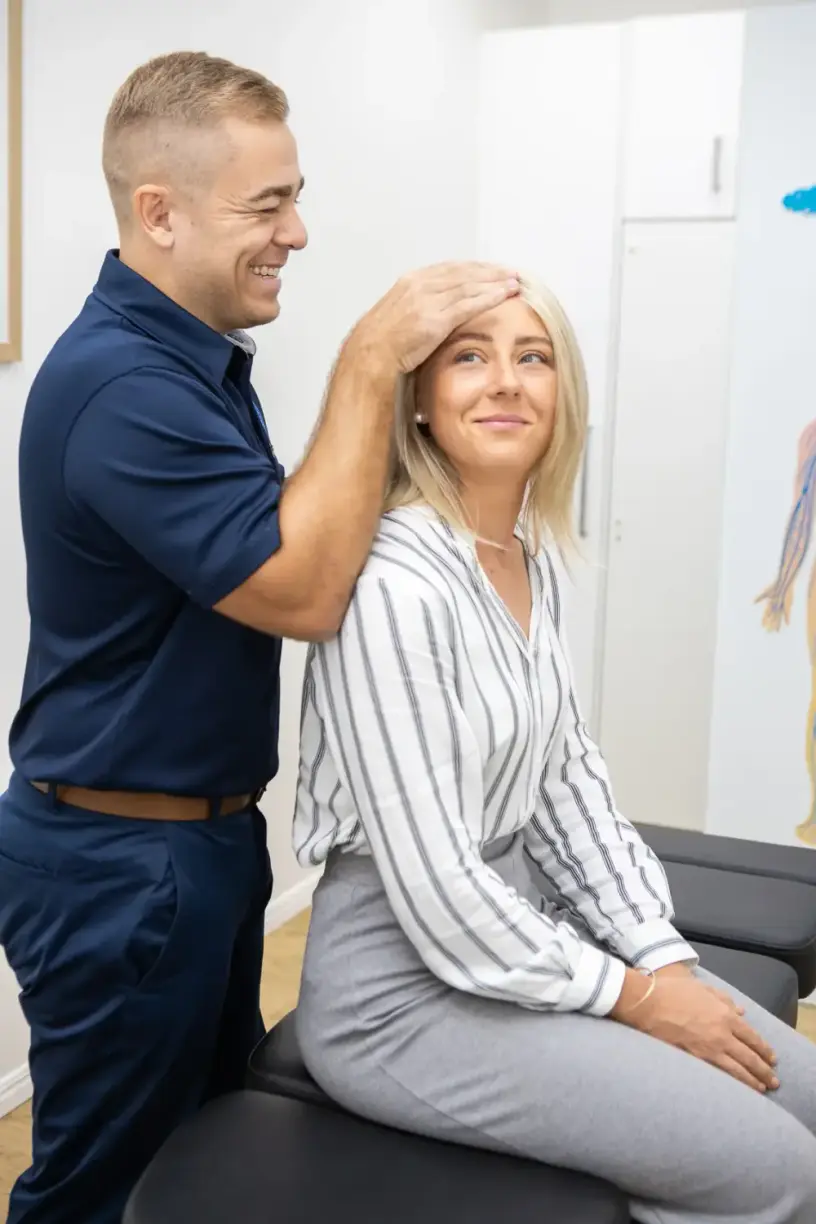
We start with a postural and movement assessment — looking at the position of your head relative to your shoulders, the curvature of your cervical and thoracic spine, and the balance of muscles supporting your upper body. This gives us a clear picture of which structures are tight, which are weak, and which joints have lost normal movement. Care for posture-related pain and tech neck at Banora Chiropractic may include cervical and thoracic adjustments to restore normal joint mobility and reduce the stiffness that makes good posture hard to maintain, soft tissue work on the tight structures — particularly the suboccipital muscles, chest, and anterior shoulder — that pull the head and shoulders forward, and a progressive exercise program targeting the deep neck flexors, rhomboids, and lower trapezius that support an upright position. Just as importantly, we provide practical ergonomic advice specific to your work setup — screen height, chair position, phone habits, and movement breaks — so that the improvements from care carry over into your daily life. Lasting posture improvement comes from a combination of structural correction and behavioural change, and we help you with both.
What to expect at Banora Chiropractic
Your first appointment includes a thorough postural assessment and movement analysis. We take time to understand how your working day is structured — how many hours you spend seated, what your typical posture looks like, and what you have already tried. We will then examine your neck, upper back, and shoulders, and explain what we find in plain, practical language. Improvement in posture-related pain is usually noticeable within the first few weeks of care. Joint stiffness responds relatively quickly to chiropractic adjustments; muscle balance and strength takes longer to develop. We will give you a realistic timeline based on your assessment and keep track of how both your symptoms and your posture change over time. You will be given exercises at each visit that are appropriate to your current stage — not a long list to work through alone, but specific movements we can teach you properly and progress as you improve. Most people find that a combination of a focused care period followed by periodic maintenance visits — and the habit changes we help you establish — leads to sustained improvement.
Get Help With Posture & Tech Neck
Book an assessment and let us help you understand what is going on.
Book Online Call (07) 5599 2322Related Services
Related Conditions
Frequently Asked Questions About Posture & Tech Neck
Struggling with posture & tech neck?
You do not have to just put up with it. Book an assessment and let us help you understand your options.